8 min read
⏱ 9 min read
How Does Video Game Limits That Actually Work for Kids Impact Your Family is a pressing concern for families navigating today’s digital landscape. Research from child development specialists shows that balanced, intentional tech use supports healthy growth rather than hindering it. We break down the latest evidence-based guidance below.
Thinking Before Editing

Diagnosis confirmed: The draft has strong bones but suffers from:

- Em dashes throughout (need conversion to semicolons or commas)
- One severe zoom-out conclusion (“applies to social media, to alcohol, to work…”)
- Vague abstractions (“changes the dynamic considerably,” “that skill doesn’t stay in the gaming context”)
- Some hedging that can tighten (“may help,” “tends to”)
- A few repetitive internal sentence structures
Approach: Surgical edits preserving all content and structure. Convert em dashes systematically. Ground abstractions with specifics. Replace the zoom-out conclusion with something actionable. Tighten hedging where appropriate; add hedging where claims lack support.
The Real Problem With One-Hour Gaming Limits
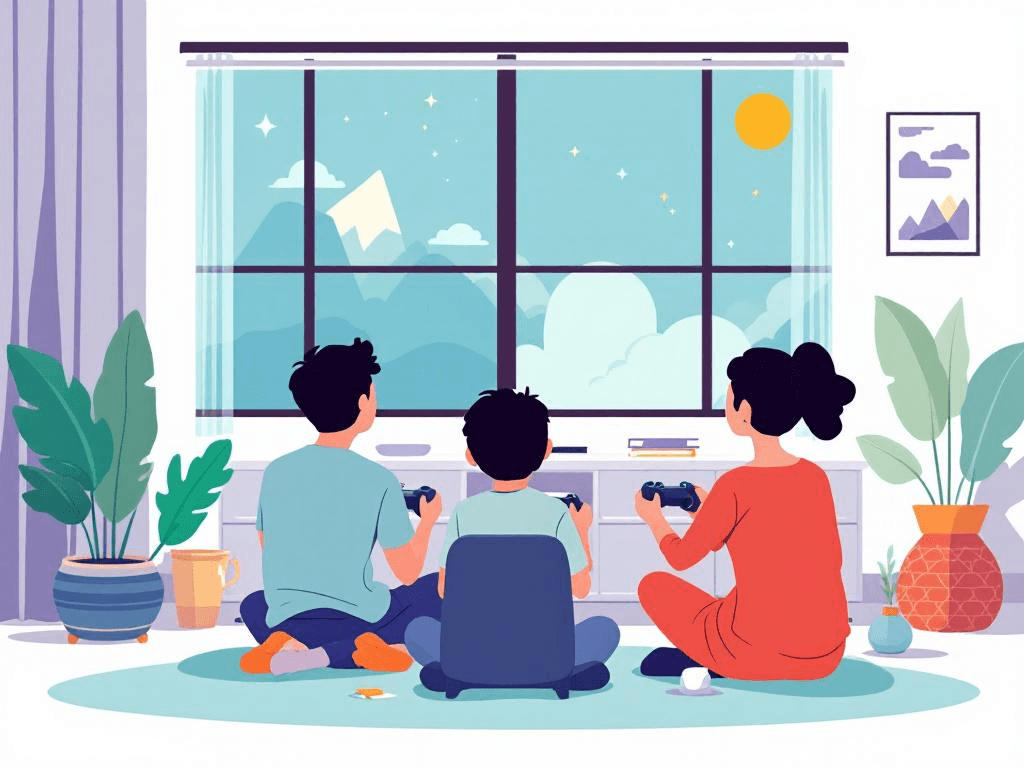
Picture a Saturday morning. You’ve already decided: one hour of gaming, then they’re outside. You feel good about this. It’s a clear rule, it’s reasonable, and you’ve communicated it calmly. By 10:47 a.m. you’re in a negotiation you didn’t agree to enter, someone is crying, and you’re wondering whether you’re the problem.
You’re not. But the rule might be.
The “one-hour limit” became cultural shorthand partly because of American Academy of Pediatrics guidance that, in earlier iterations, prescribed specific daily maximums for kids gaming. Media coverage simplified it further. The number stuck. The problem is that a flat time cap treats 60 minutes of a story-driven single-player game the same as 60 minutes of a live-service multiplayer shooter; treats a 7-year-old the same as a 14-year-old; treats a kid who just finished homework and soccer practice the same as one who’s been horizontal since 8 a.m.
Context gets erased.
Excessive gaming does carry real risks. But the word “excessive” is doing enormous work in that sentence, and it deserves more precision than a kitchen timer can provide. Healthy video game limits aren’t fundamentally about the clock. They’re about building a framework that accounts for what your kid is actually playing, what stage they’re at developmentally, and what your family’s real competing demands look like.
Not All Gaming Is the Same Category
Before you can set smart limits, you need to understand what you’re limiting; not all kids gaming is the same behavioral category. Games exist on a spectrum of what designers call “compulsion loops”; the mechanics that make you want to play just one more round, open one more chest, complete one more objective.
Narrative single-player games like The Legend of Zelda or Stardew Valley have natural endpoints built in: you finish a dungeon, you save, you close the console. The game isn’t fighting you when you try to stop. Live-service multiplayer games like Fortnite, Roblox, or most mobile games are architecturally different. They’re engineered for indefinite play; there is always one more match, one more daily challenge, one more limited-time event.
This isn’t an accident or a flaw. It’s the business model. A 90-minute session of a narrative game is behaviorally different from 90 minutes of a live-service title. The first has natural resting points; the second is specifically designed to eliminate them. Neither is automatically harmful, but they require different thinking when you’re trying to set limits that actually work.
A quick way to assess a game’s stickiness design: look for daily login bonuses, battle passes with expiring rewards, or social features that create obligation (“your friends are online now”). These mechanics aren’t evidence the game is bad; they’re evidence that stopping will feel harder, and your limit-setting strategy should account for that.
What the Research Actually Says
The research on kids gaming is more nuanced than most parenting headlines suggest; it’s also more honest about its own gaps than most parenting articles admit. Andrew Przybylski and colleagues at the Oxford Internet Institute have published work suggesting that moderate gaming is associated with better wellbeing outcomes in children than no gaming at all. The kids with zero gaming time didn’t show advantages on social or emotional measures in their research. This doesn’t mean gaming is inherently good; it means the picture is more complicated than “less is always more.”
The World Health Organization did classify gaming disorder in 2019, which generated significant coverage. What the classification actually requires is worth knowing: persistent gaming behavior causing significant distress or functional impairment, lasting at least 12 months. It’s not a diagnosis for kids who really love video games or get upset when you turn them off. The bar is high, and that’s intentional.
The most useful research framing for practical parenting is the displacement hypothesis: gaming itself isn’t typically the primary problem; what gaming displaces is. Sleep, homework, physical activity, face-to-face social time; when gaming consistently crowds these out, that’s where harm appears to accumulate. This reframes the central question. Instead of “how many hours is my kid gaming?”, the more useful question is “what is gaming replacing in my child’s day?”
The honest caveat: longitudinal research on kids gaming is still catching up to how fast games have evolved. Studies conducted on 2012 gaming behavior have limited applicability to 2024 live-service ecosystems. Treat research as directional guidance, not settled law. Bark alerts you to concerning content without invading privacy. Try Bark free for 7 days.
A Framework That Actually Works
Start with protected zones, not time caps. Rather than deciding how much gaming is allowed, decide first what gaming cannot displace. For most families, that list includes: adequate sleep (which means a hard cutoff time in the evening, not a suggestion), homework completion, at least one family meal, and some form of physical activity or outdoor time. These are non-negotiables; not because gaming is bad, but because these things are necessary. Frame them to your kids as protected zones, not punishments. “Gaming can’t happen until homework is done” lands differently than “you’re only allowed one hour.” One is a condition; the other is an arbitrary ceiling. The protected-zones approach also scales naturally as kids get older and earn more autonomy; the zones don’t change, but the space within them expands.
Use natural stopping points instead of timers. A kitchen timer going off mid-match is a reliable conflict generator. It’s not that your kid is being dramatic; they’re being interrupted at a moment the game has specifically engineered to feel unresolvable. Teach kids to identify natural stopping points before they start playing: the end of a level, the end of a match, a save point. This is a real skill, and it can transfer to other contexts where they need to disengage from something engaging. Pair it with transition warnings; a 10-minute heads-up before the expected stop time, the same way a good preschool teacher signals the end of free play. The warning reduces the abruptness; the natural stopping point reduces the conflict.
Differentiate weekdays from weekends. Weekday video game limits should be tighter by default, not as punishment, but because competing demands are genuinely higher; there’s less slack in the system. Weekend sessions can run longer while still operating within the protected-zones framework. Letting kids have input on weekend gaming schedules — “do you want to play in the morning or after lunch?” — increases buy-in substantially. They’re not negotiating the framework; they’re making choices within it. That distinction matters for how they experience the limit.
Make it an ongoing conversation, not a one-time decree. Kids’ gaming preferences change, their self-regulation capacity develops, and the games themselves change. A quarterly check-in doesn’t have to be formal; it can be a 10-minute conversation. The questions worth asking: Are they sleeping well? Is their social life intact? Are grades stable? When they do stop gaming, do they recover and engage with other things, or do they stay dysregulated? These questions tell you more than screen time logs.
Normal vs. Concerning Gaming Behavior
Some parental anxiety about gaming is calibrated accurately; some isn’t. It helps to know the difference. Normal behavior includes strong preference for gaming over other activities, visible disappointment when sessions end, talking about games at length, and wanting to play whenever the opportunity exists. This is what it looks like when kids find something genuinely engaging. It’s not typically a warning sign on its own.
Concerning behavior looks different: inability to stop even when the child clearly wants to, gaming through hunger or physical discomfort without noticing, withdrawal from all non-gaming friendships over an extended period, and mood dysregulation that persists for hours after gaming ends; not the 20-minute grumpiness of a hard stop, but sustained distress that doesn’t resolve. A useful informal test: if you removed gaming for one day, would your child recover and engage with other activities by evening? Most kids, even heavy gamers, tend to recalibrate. A child who remains dysregulated, disengaged, or unable to find any other source of interest after a full day is showing you something worth paying attention to.
If you’re genuinely concerned, talking to a pediatrician or family therapist is a low-stakes first step. It doesn’t require a crisis to justify the conversation; it’s just getting more information.
The Most Underrated Strategy: Play With Your Kids
Here’s something the limits-and-rules framing tends to crowd out: playing with your kids is one of the most effective things you can do for their gaming relationship, and you don’t have to be good at it. Research on co-play — parents gaming alongside their children — suggests that kids whose parents occasionally play with them tend to communicate more openly about gaming content and may demonstrate better self-regulation. The mechanism appears straightforward. When you’ve actually played Minecraft for 20 minutes, you understand what you’re setting limits around. You also have a conversation starter that didn’t exist before.
You don’t need to become a competent gamer. Ask your kid to teach you. Watch them play for 15 minutes and ask genuine questions. Try a cooperative game together once a month where you’re on the same team. Once you’ve sat through a Fortnite match, you’re no longer regulating something abstract; you’re making decisions about something you’ve seen firsthand, and your kid knows you’ve seen it.
The Goal: Self-Regulation, Not Compliance
The goal of video game limits was never really compliance. It was always self-regulation: the capacity to recognize when something compelling is crowding out something necessary, and to make a conscious choice. A limit that a child eventually internalizes because it makes sense to them, not because you’re enforcing it, is worth ten limits you have to relitigate every Saturday morning.
So the shift isn’t from permissive to strict. It’s from “how long?” to “what framework fits this kid, at this age, in this family?” Start by identifying your three protected zones. Have one conversation with your kid about what they are and why. Not a lecture; a conversation. That’s the concrete assignment for this week.
Want to learn more? Explore our latest articles on the homepage.
Enjoyed this digital parenting & family tech article?
Get practical insights like this delivered to your inbox.
Subscribe for Free